
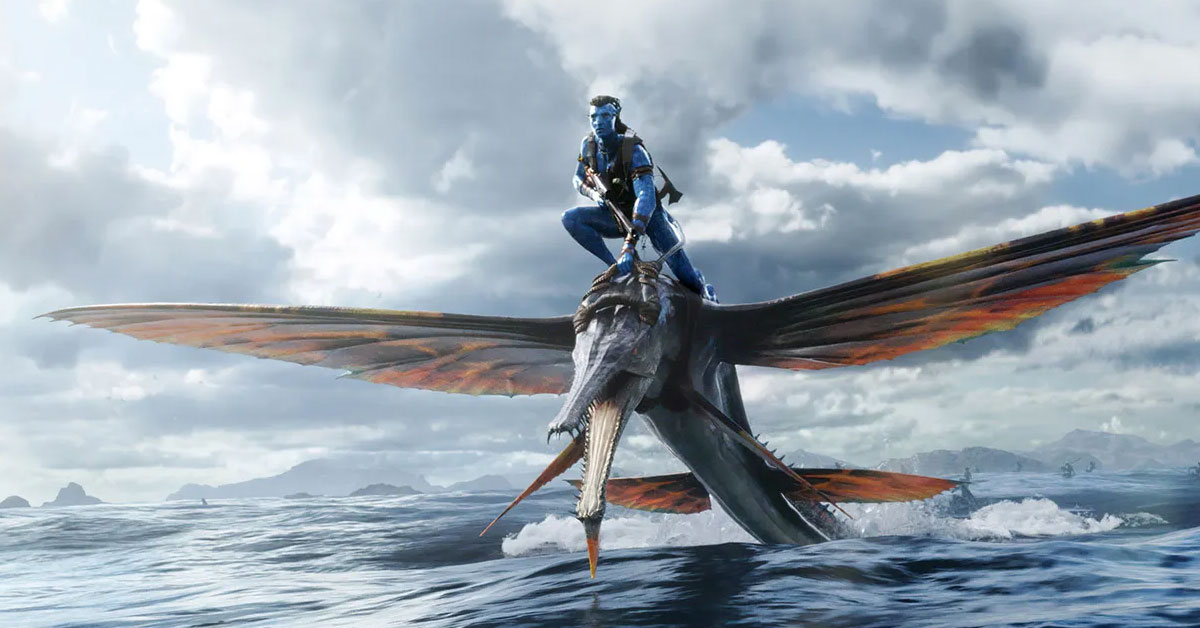
Avatar: The Way of Water is the spectacular sequel to the original ‘Avatar’ film created by James Cameron in 2009. It was a long time coming, and it was worth the wait.
Visually sumptuous, Cameron made great use of the advances in CGI and 3D technology, crafting an underwater world that is even more extraordinarily engaging than the first which depicted the marvelous creatures and forests of Pandora.
Now Jake Sully, played by Sam Worthington, is the leader of the Na’vi and he and his mate Neytiri, portrayed once again by Zoe Saldana, are living happily in the forests of Pandora with their family of four hybrid children and an abandoned human boy called Spider. But the “Sky People” – savage, greedy Earthlings – have returned with a vendetta to kill Sully and destroy everything that stands in their way of doing so. To save his people and the sacred forests, Sully takes his family to seek refuge with clans of the Water People on the atolls of Pandora. There, too, unscrupulous Sky People are wreaking havoc, murdering a highly intelligent and advanced species of whale-like beings called the Tulkun for a substance in their cerebrum that stops human aging.
Sully and his family are fighting battles on two fronts – in their personal struggle to blend into the new culture of the Water People, and fighting a vicious war with the Sky People determined to destroy the Sully family and plunder Pandora.
All the characters you loved (and hated) in the first ‘Avatar’ are back – in one way or another – including Dr. Grace Augustine and the villainous Colonel Miles Quaritch, both of whom died in the original. The film explains their fascinating return but doesn’t get bogged down in techno-babble to do so. As with the rest of the film, you become mesmerized by the worlds of Pandora, which Cameron has taken extraordinary pains to make feel incredibly believable.
There are several of the same themes as in the first film – caring for the planet and its people and fighting for what you believe in – with an added dimension of the importance of family. The movie takes its time creating the underwater world, but it is time well spent. Also, we are treated to more of the Na’vi language – spoken, signed, and sung. Cameron worked with linguist Paul Frommer to construct a realistic language, heavily based on the Maori language – with vocabulary and grammar. It’s beautiful to hear and adds to the sense of total immersion into another world.
Composer Simon Franglen picked up the mantle left by the death of previous ‘Avatar’ composer James Horner, working for most of the last three years on the score. Immediately after the score’s release it began garnering industry awards. If there is such a phrase as “ethereally aqueous” that would describe Franglen’s work. It evokes the feel of the oceans and of other worlds all at once.
This is a movie that should be seen on the largest format possible, in 3D if you have access to it. The visuals are resplendent and made for the big screen. There are at least two more sequels in the works for this franchise, and if each of them lives up the astonishing accomplishments of the first two, we are in for a feast of visual and musical treats.