
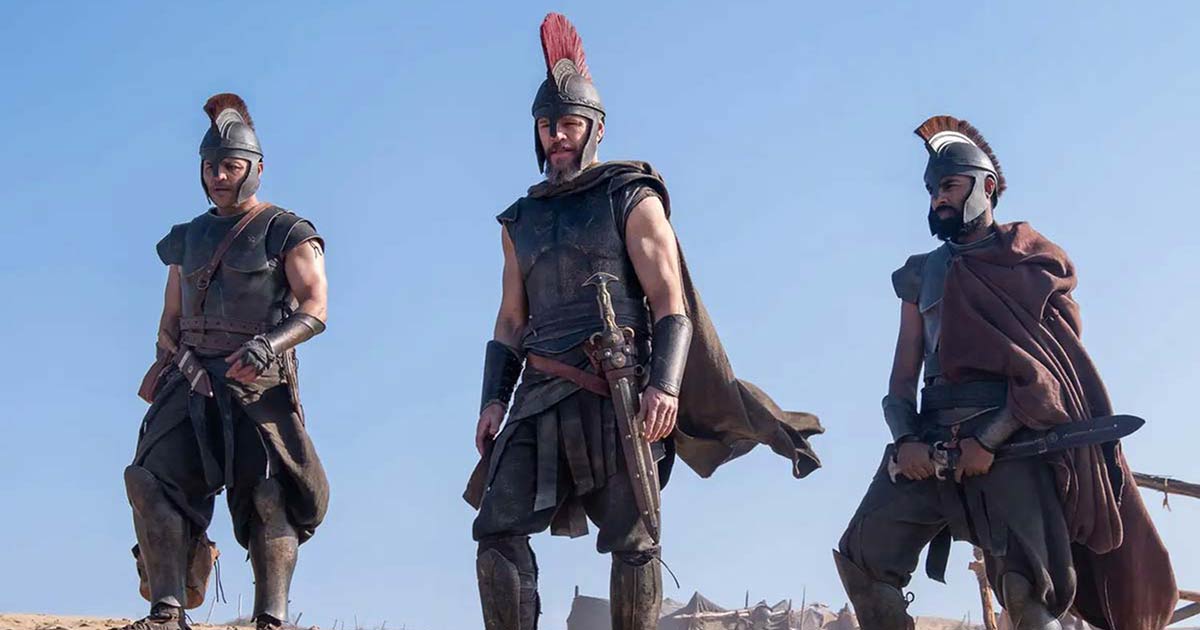
The Odyssey is acknowledged as one of the greatest stories in Western civilization. When the blind poet Homer crafted the story following the Trojan War, it was to honor the warrior Odysseus, the Greek hero of the story. When Christopher Nolan crafted his own cinematic version of the tale – in 70 mm no less – it was to create spectacle, which it does marvelously, but he also managed to dodge “Sword and Sandal” clichés and depict the tragedy of war as it weighs on the human soul.
Matt Damon portrays Odysseus with flashing armor and bulging biceps, but also with great pathos and emotion. You feel the burden of command as he sees his men fight and die. He shows the emotional devastation of endless war and the agonizing longing for home and family with his entire being. Robert Pattinson plays the villainous suitor Antinous who has designs on Odysseus’ kingdom, and his wife. Tom Holland is the young Telemachus, giving the role a believable aura of the uncertainty and rashness of youth. Anne Hathaway is the faithful and fiery wife of Odysseus, Penelope, whose home has been overrun with sordid suitors who feast nightly and try to convince her that her husband is dead and she must take one of them as her mate. The gods are not seen as something glorious on high Mt. Olympus, but as beings that walk among us mortals, influencing and interacting with humans.
The film is packed with Nolan’s signature rapid-paced action scenes, outstanding visuals, and plenty of ferocious combat on a staggering scale. He brings the monsters of the tales to life, including the Cyclops and Scylla, who lurks in a narrow passageway, eager to wreck ships and gobble their crew. Christopher Nolan also makes us aware of the monsters within us all. Odysseus triumphs because he values cleverness over brutality. He knows he has violated “the law of Zeus” – hospitality to all – when he and his men conceal themselves in the infamous Trojan Horse and destroy the city, bringing the wrath of the gods upon them.
Composer Ludwig Goransson chose a more authentic approach to the music, invoking the Bronze Age by using ancient Greek instruments like the lyre – a harp-like instrument – and an aulos – an ancient wind instrument along with massive bronze gongs. The result is almost organic, blending in with the action and the visuals seamlessly.
The Odyssey doesn’t feel like a history lesson. It doesn’t feel like it’s over two hours long. It feels like a journey of what it’s like to be human. Allow me to borrow a phrase from the Greek poets: “Οι θεοί θα ήταν ευχαριστημένοι” – “The gods would be pleased”.